Passer aux informations produits
1 de 17

PUH - Onduleur à onde sinusoïdale pure 12V 3000W avec commutateur de transfert UPS et Bluetooth intégré

PUH - Onduleur à onde sinusoïdale pure 12V 3000W avec commutateur de transfert UPS et Bluetooth intégré

Prix habituel $516.00 CAD
Prix habituel $688.00 CAD Prix promotionnel $516.00 CAD
Promotion Épuisé
Quantité
DESCRIPTION

Aperçu de l'onduleur Renogy PUH 3000W

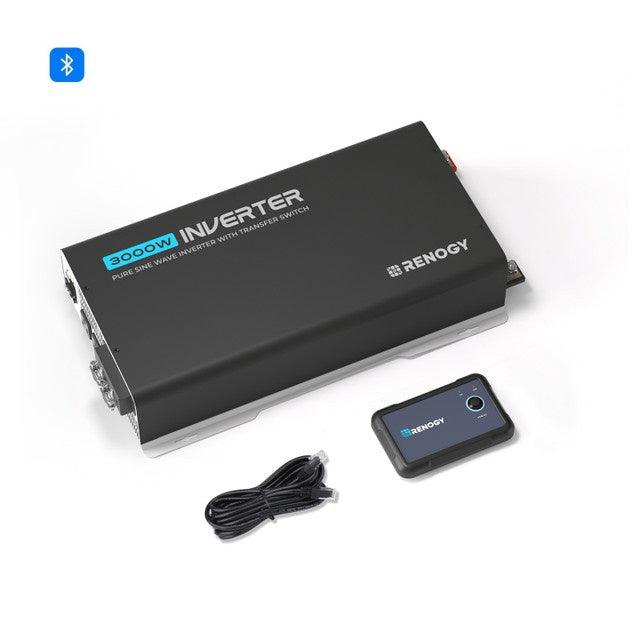
Boostez vos aventures hors réseau avec l'onduleur Renogy PUH 3000W, qui transforme l'énergie de la batterie 12V DC en une sortie sinusoïdale pure et stable de 120V AC, essentielle pour les camping-cars, les bateaux, les camions et les systèmes de secours d'urgence.

Avec une puissance continue de 3000W (6000W en pointe pendant 2s) et une efficacité supérieure à 92 %, il alimente des charges exigeantes comme les climatiseurs, les réfrigérateurs et les outils sans distorsion (THD ≤3%), tandis que le commutateur de transfert UPS permet un basculement transparent <30ms entre l'alimentation secteur et la batterie pour des performances ininterrompues.

Surveillance intelligente avec Bluetooth et télécommande

Le Bluetooth intégré s'intègre à l'application DC Home pour des informations en temps réel sur la tension, le courant, la consommation d'énergie et les alertes, complété par une télécommande filaire de 5 m pour un contrôle sans effort.

Des protections complètes protègent contre les surtensions, les surintensités, les courts-circuits, les surcharges et la batterie faible, avec un fonctionnement silencieux (<55dB) grâce à des ventilateurs intelligents.

Durable et convivial, avec un poids de 6,7 kg (14,8 livres) et des dimensions de 48,8 x 26,4 x 9,7 cm (19,2 x 10,4 x 3,8 pouces), il est certifié UL458 pour sa fiabilité.

Expédition

Les commandes sont traitées dans un délai de 1 à 3 jours ouvrables. La livraison prend généralement 7 à 14 jours ouvrables pour les commandes nationales et 10 à 20 jours pour les expéditions internationales. Les informations de suivi vous seront communiquées une fois votre commande expédiée.

Afficher tous les détails

Ships from: CAN

Recently Viewed

Frequently Asked Questions

A good 3000W pure sine wave inverter should match your battery voltage, handle startup surges, protect sensitive electronics, and switch power reliably if you use it for backup. For most mobile and off-grid systems, pure sine wave output is important because it provides cleaner AC power for devices like laptops, CPAP machines, battery chargers, TVs, and some appliances that can run poorly on modified sine wave power. This model converts 12V DC battery power to 120V AC, delivers 3000W continuous power, and supports 6000W surge power for up to 2 seconds. That makes it a practical fit for loads with higher startup demand, such as some small pumps, tools, or kitchen appliances. It also has low total harmonic distortion of 3% or less, which helps support stable operation for sensitive electronics. Shoppers who want backup convenience should also look at transfer time and monitoring features. This inverter includes a UPS transfer switch with under 30ms switching and Bluetooth monitoring through the DC Home app. The main tradeoff is that a 12V 3000W inverter can draw very high current, so it requires appropriately sized cables, fusing, and a battery bank designed for heavy loads.
Yes, a 12V 3000W inverter can be a strong backup option for essential household devices, as long as your battery bank is sized correctly and the combined load stays within the inverter's limits. A 3000W pure sine wave inverter is commonly used for outage support because it can run many everyday items such as refrigerators, lights, routers, laptops, CPAP machines, and small kitchen appliances, while delivering utility-style 120V AC power. The Renogy PUH 3000W model provides 3000W continuous output and 6000W surge capacity, which is useful for appliances that need extra power at startup. Its UPS transfer switch can move to battery power in less than 30ms, helping keep connected equipment running with minimal interruption. That can be especially helpful for home office gear, networking equipment, and certain medical devices. The main limitation is battery demand. At full output, a 12V inverter pulls substantial DC current, so this setup works best with a robust lithium battery bank and proper wiring. It is a better fit for essential circuits and selected appliances than for whole-home backup or large 240V loads such as central air conditioning.
A pure sine wave inverter is usually the better choice for sensitive electronics, modern appliances, and mixed-use off-grid systems. It produces a smoother AC waveform that more closely matches utility power, which helps devices run cooler, quieter, and more reliably. Modified sine wave inverters can be cheaper, but they are more likely to cause issues with CPAP machines, audio equipment, microwaves, variable-speed tools, battery chargers, and some appliances with electronic controls. This inverter is designed specifically for clean power applications. It provides 120V AC pure sine wave output from a 12V battery system, with efficiency above 92% and total harmonic distortion at 3% or less. Those specs make it a strong option for RVs, boats, trucks, and emergency backup setups where people often need to run both sensitive electronics and occasional higher-surge devices. It also adds practical features that some basic inverters do not include, such as Bluetooth monitoring, a 16.4-foot wired remote, quiet cooling fans under 55dB, and a UPS transfer switch. The tradeoff is that pure sine wave models are typically chosen for performance and compatibility rather than the lowest upfront cost.

Frequently Asked Questions

A good 3000W pure sine wave inverter should match your battery voltage, handle startup surges, protect sensitive electronics, and switch power reliably if you use it for backup. For most mobile and off-grid systems, pure sine wave output is important because it provides cleaner AC power for devices like laptops, CPAP machines, battery chargers, TVs, and some appliances that can run poorly on modified sine wave power. This model converts 12V DC battery power to 120V AC, delivers 3000W continuous power, and supports 6000W surge power for up to 2 seconds. That makes it a practical fit for loads with higher startup demand, such as some small pumps, tools, or kitchen appliances. It also has low total harmonic distortion of 3% or less, which helps support stable operation for sensitive electronics. Shoppers who want backup convenience should also look at transfer time and monitoring features. This inverter includes a UPS transfer switch with under 30ms switching and Bluetooth monitoring through the DC Home app. The main tradeoff is that a 12V 3000W inverter can draw very high current, so it requires appropriately sized cables, fusing, and a battery bank designed for heavy loads.
Yes, a 12V 3000W inverter can be a strong backup option for essential household devices, as long as your battery bank is sized correctly and the combined load stays within the inverter's limits. A 3000W pure sine wave inverter is commonly used for outage support because it can run many everyday items such as refrigerators, lights, routers, laptops, CPAP machines, and small kitchen appliances, while delivering utility-style 120V AC power. The Renogy PUH 3000W model provides 3000W continuous output and 6000W surge capacity, which is useful for appliances that need extra power at startup. Its UPS transfer switch can move to battery power in less than 30ms, helping keep connected equipment running with minimal interruption. That can be especially helpful for home office gear, networking equipment, and certain medical devices. The main limitation is battery demand. At full output, a 12V inverter pulls substantial DC current, so this setup works best with a robust lithium battery bank and proper wiring. It is a better fit for essential circuits and selected appliances than for whole-home backup or large 240V loads such as central air conditioning.
A pure sine wave inverter is usually the better choice for sensitive electronics, modern appliances, and mixed-use off-grid systems. It produces a smoother AC waveform that more closely matches utility power, which helps devices run cooler, quieter, and more reliably. Modified sine wave inverters can be cheaper, but they are more likely to cause issues with CPAP machines, audio equipment, microwaves, variable-speed tools, battery chargers, and some appliances with electronic controls. This inverter is designed specifically for clean power applications. It provides 120V AC pure sine wave output from a 12V battery system, with efficiency above 92% and total harmonic distortion at 3% or less. Those specs make it a strong option for RVs, boats, trucks, and emergency backup setups where people often need to run both sensitive electronics and occasional higher-surge devices. It also adds practical features that some basic inverters do not include, such as Bluetooth monitoring, a 16.4-foot wired remote, quiet cooling fans under 55dB, and a UPS transfer switch. The tradeoff is that pure sine wave models are typically chosen for performance and compatibility rather than the lowest upfront cost.