Passer aux informations produits
1 de 11

Panneau solaire rigide 100 W 4 pièces (Topcon)

Panneau solaire rigide 100 W 4 pièces (Topcon)

Prix habituel $442.00 CAD
Prix habituel $680.00 CAD Prix promotionnel $442.00 CAD
Promotion Épuisé
Ship from
Quantité
DESCRIPTION

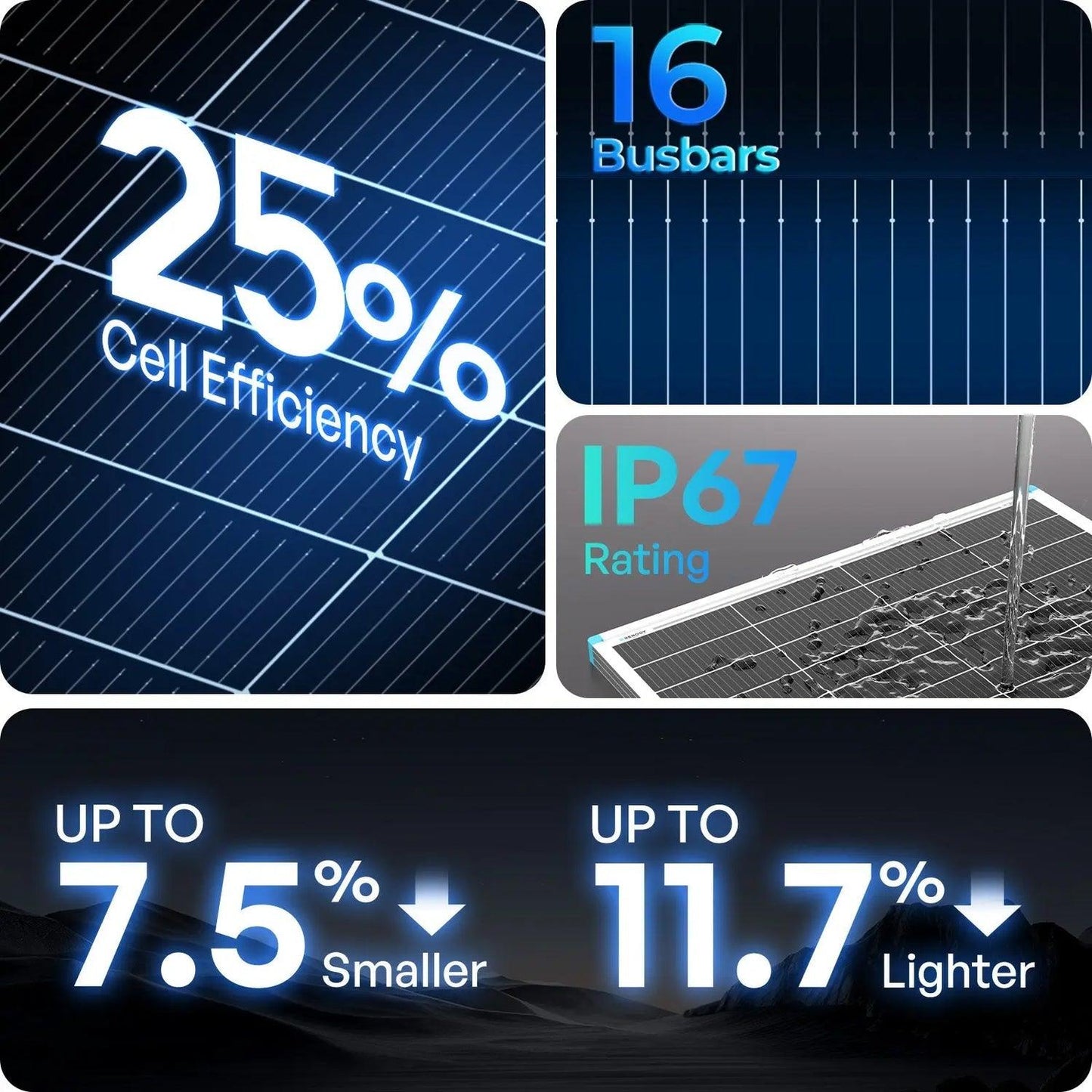
Panneau solaire rigide Renogy 100W 4 pièces (Topcon)

Ce lot de 4 panneaux rigides Renogy 100W (Topcon) est conçu pour une recharge solaire fiable.

Utilisez-le pour les VR, les fourgonnettes, les cabanes ou les configurations de secours.

Quatre panneaux identiques vous aident à dimensionner un système avec une sortie cohérente.

Ils fonctionnent bien pour les montages sur toit et les installations au sol.

Planifiez votre disposition pour réduire l'ombrage et améliorer les performances.

Associez l'ensemble à du matériel de montage et un câblage compatibles.

Ajoutez un régulateur de charge et une batterie pour stocker l'énergie pour une utilisation ultérieure.

Pour de meilleurs résultats, gardez les quatre modules orientés dans la même direction.

Orientez-les vers le soleil et ajustez-les saisonnièrement si possible.

Nettoyez la surface vitrée lorsque la poussière ou le pollen s'accumulent.

Rincez à l'eau et essuyez avec un chiffon doux.

Évitez les produits chimiques agressifs et les tampons abrasifs.

Vérifiez les fixations après de longs trajets ou de forts vents.

Resserrez le matériel si vous remarquez des vibrations ou des mouvements.

Inspectez les câbles pour l'usure et protégez-les des bords tranchants.

Acheminez le câblage proprement pour éviter les accrocs et les infiltrations d'eau.

Cet ensemble est un choix judicieux lorsque vous souhaitez un chemin d'extension simple.

Il prend en charge les cas d'utilisation solaire courants comme les lumières, les ventilateurs et la recharge d'appareils.

La sortie réelle dépend des heures d'ensoleillement, de la température et de la conception du système.

Confirmez les limites d'entrée de votre contrôleur avant de connecter plusieurs unités.

Si vous comparez les options, concentrez-vous sur l'encombrement et les points de montage.

Mesurez votre espace disponible avant d'installer.

Lors de l'emballage pour le voyage, fixez les pièces pour éviter d'endommager le cadre.

Considérez-le comme une amélioration acoustique pour l'indépendance énergétique.

Il ajoute une puissance silencieuse et constante sans générateur bruyant.

Si jamais vous avez besoin de travaux de carrosserie autour des supports, consultez un carrossier.

Ils peuvent aider à protéger la surface et la finition du toit.

Pour une planification de système plus approfondie, un panéliste peut cartographier la disposition de votre tableau.

Cela aide à équilibrer l'ombre, les longueurs de câble et l'accès général.

Choisissez un emplacement de montage sûr avec de la place pour la circulation de l'air.

Une bonne circulation de l'air aide à gérer la chaleur et à maintenir l'efficacité.

Avec un entretien approprié, ce kit reste prêt pour une utilisation quotidienne en extérieur.

Expédition

Les commandes sont traitées dans un délai de 1 à 3 jours ouvrables. La livraison prend généralement 7 à 14 jours ouvrables pour les commandes nationales et 10 à 20 jours pour les expéditions internationales. Les informations de suivi vous seront communiquées une fois votre commande expédiée.

Afficher tous les détails

Ships from: CAN

Recently Viewed

Frequently Asked Questions

A 400W solar panel kit is a practical entry-to-mid-size setup for light to moderate off-grid power needs, but whether it is enough depends on what you want to run and how much sunlight you get. In general, 400W of solar is well suited for charging a battery bank that supports lights, phones, laptops, routers, small fans, CPAP machines, and efficient 12V appliances in an RV, van, cabin, or backup system. It can also help offset refrigerator use when paired with adequate battery storage and an inverter, though heavy loads like air conditioners, electric heaters, or full-home backup usually need a much larger system. The Renogy 100W N-Type TOPCon Rigid Solar Panel 4-Pack provides four matched 100W panels for 400W total output, which helps keep array performance consistent and makes expansion easier later. It supports both 12V and 24V battery systems and can be wired in series or parallel depending on your charge controller and system design. This type of kit is best for homeowners wanting essential backup power and travelers building a dependable small solar setup. The tradeoff is that solar production changes with weather, season, panel angle, and shading, so battery capacity and system sizing still matter.
Rigid solar panels are usually the better choice when you want long-term durability, stable output, and a more permanent installation. They typically use tempered glass and aluminum framing, which helps them handle weather, vibration, and repeated outdoor use better than many lightweight portable or flexible options. If your goal is reliable power for an RV roof, cabin, boat, shed, or ground-mounted backup setup, rigid panels are often the strongest fit. The Renogy 100W N-Type TOPCon Rigid Solar Panel 4-Pack is built around that use case. It uses N-Type TOPCon monocrystalline cells, tempered glass, and a corrosion-resistant aluminum frame. It is designed for rooftop or ground-mount installation and uses MC4-compatible connections for standard solar integration. Portable folding panels are easier to move and store, while flexible panels can be helpful on curved surfaces or where low weight matters most. The tradeoff is that those alternatives may offer less structural protection and may not be ideal for long-term fixed installations. Shoppers who want a dependable, expandable solar array for everyday off-grid charging usually benefit more from a rigid panel kit like this one.
Yes. This four-panel kit is designed to work with both 12V and 24V battery systems when paired with the appropriate charge controller and system components. That makes it flexible for common off-grid applications such as RVs, camper vans, cabins, boats, and small home backup systems. The Renogy 100W N-Type TOPCon Rigid Solar Panel 4-Pack includes four matched 100W rigid panels with MC4-compatible connectors, so integration with many standard solar setups is straightforward. The panels can be wired in series or parallel depending on your system voltage, cable run, controller limits, and expansion plans. Series wiring is often used to raise voltage and reduce current over longer runs, while parallel wiring can be useful for maintaining system voltage and reducing the effect of shading on one panel. These panels are intended for roof-mounted or ground-mounted installations rather than handheld portability. They are a good fit for shoppers building a fixed solar array with room to grow. The main limitation is that you will still need mounting hardware, a charge controller, wiring, and battery storage to create a complete working system.

Frequently Asked Questions

A 400W solar panel kit is a practical entry-to-mid-size setup for light to moderate off-grid power needs, but whether it is enough depends on what you want to run and how much sunlight you get. In general, 400W of solar is well suited for charging a battery bank that supports lights, phones, laptops, routers, small fans, CPAP machines, and efficient 12V appliances in an RV, van, cabin, or backup system. It can also help offset refrigerator use when paired with adequate battery storage and an inverter, though heavy loads like air conditioners, electric heaters, or full-home backup usually need a much larger system. The Renogy 100W N-Type TOPCon Rigid Solar Panel 4-Pack provides four matched 100W panels for 400W total output, which helps keep array performance consistent and makes expansion easier later. It supports both 12V and 24V battery systems and can be wired in series or parallel depending on your charge controller and system design. This type of kit is best for homeowners wanting essential backup power and travelers building a dependable small solar setup. The tradeoff is that solar production changes with weather, season, panel angle, and shading, so battery capacity and system sizing still matter.
Rigid solar panels are usually the better choice when you want long-term durability, stable output, and a more permanent installation. They typically use tempered glass and aluminum framing, which helps them handle weather, vibration, and repeated outdoor use better than many lightweight portable or flexible options. If your goal is reliable power for an RV roof, cabin, boat, shed, or ground-mounted backup setup, rigid panels are often the strongest fit. The Renogy 100W N-Type TOPCon Rigid Solar Panel 4-Pack is built around that use case. It uses N-Type TOPCon monocrystalline cells, tempered glass, and a corrosion-resistant aluminum frame. It is designed for rooftop or ground-mount installation and uses MC4-compatible connections for standard solar integration. Portable folding panels are easier to move and store, while flexible panels can be helpful on curved surfaces or where low weight matters most. The tradeoff is that those alternatives may offer less structural protection and may not be ideal for long-term fixed installations. Shoppers who want a dependable, expandable solar array for everyday off-grid charging usually benefit more from a rigid panel kit like this one.
Yes. This four-panel kit is designed to work with both 12V and 24V battery systems when paired with the appropriate charge controller and system components. That makes it flexible for common off-grid applications such as RVs, camper vans, cabins, boats, and small home backup systems. The Renogy 100W N-Type TOPCon Rigid Solar Panel 4-Pack includes four matched 100W rigid panels with MC4-compatible connectors, so integration with many standard solar setups is straightforward. The panels can be wired in series or parallel depending on your system voltage, cable run, controller limits, and expansion plans. Series wiring is often used to raise voltage and reduce current over longer runs, while parallel wiring can be useful for maintaining system voltage and reducing the effect of shading on one panel. These panels are intended for roof-mounted or ground-mounted installations rather than handheld portability. They are a good fit for shoppers building a fixed solar array with room to grow. The main limitation is that you will still need mounting hardware, a charge controller, wiring, and battery storage to create a complete working system.